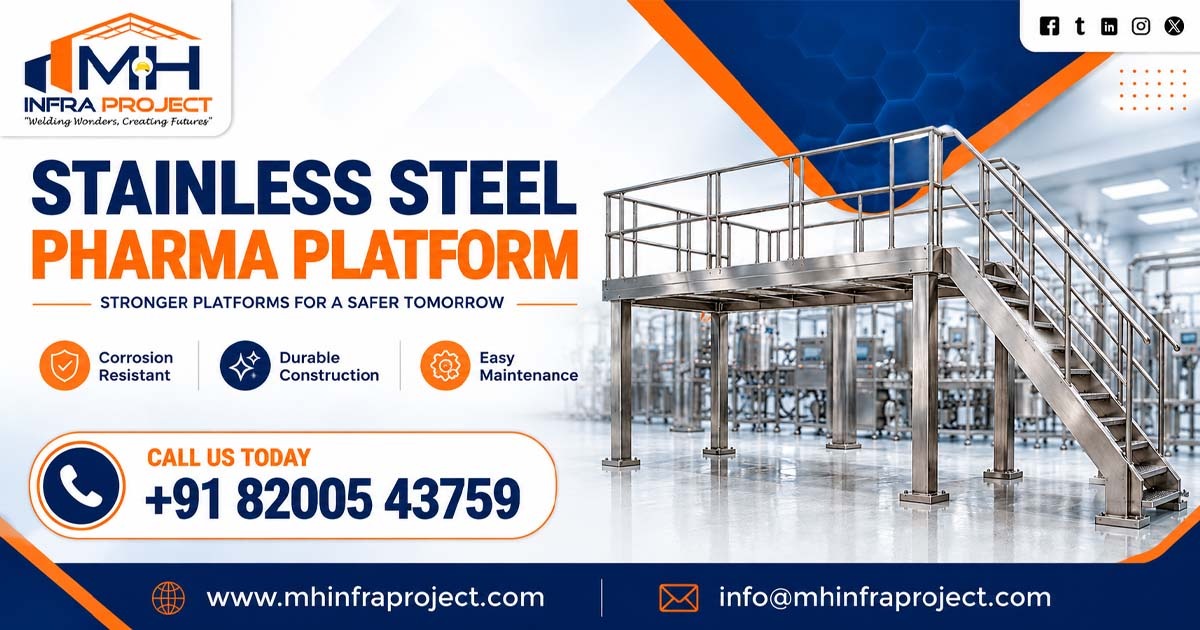
A pharmaceutical platform must provide safe equipment access without creating difficult-to-clean areas or obstructing production activities. When sourcing a Stainless Steel Pharma Platform in Andhra Pradesh, buyers should evaluate structural loading, cleaning access, material suitability, and the plant layout before approving fabrication.
1. Why Platform Layout Matters in Pharmaceutical Facilities
Pharmaceutical platforms provide elevated access to process vessels, tanks, pipelines, inspection points, and other equipment. Their design affects how operators perform routine production tasks, cleaning, sampling, and maintenance.
The platform should be planned around the actual equipment arrangement rather than selected by dimensions alone.
Key considerations include:
- Operator movement around vessels and machinery.
- Clear access to valves, instruments, and inspection openings.
- Sufficient space for cleaning and maintenance activities.
- Safe stairs, guardrails, and walking surfaces.
- Compatibility with the facility’s hygiene and operating procedures.
2. Stainless Steel Grade Must Match the Cleaning Environment
The appropriate stainless steel grade depends on the chemicals used, cleaning agents, moisture exposure, and required hygiene conditions.
SS 304 and SS 316L are not automatically interchangeable. SS 304 may suit many general-purpose environments, while SS 316L may be considered where greater resistance to certain corrosive conditions is required. The final selection should follow the facility’s material specifications and exposure assessment.
Buyers should also distinguish between corrosion resistance and hygienic design. A suitable steel grade alone does not guarantee that every joint, weld, edge, or surface is easy to clean.
3. What Should Be Checked in the Platform Structure?
The structure must support the intended working conditions, not simply the weight of the platform itself.
Ask the design or fabrication team to establish:
- Design load: Include operators, tools, stored materials where permitted, and relevant operational loads.
- Support arrangement: Confirm column positions, floor anchoring, and potential interference with existing equipment.
- Access configuration: Check stair location, platform entry points, handrails, and toe boards as applicable.
- Walking surface: Select a surface that balances slip resistance, drainage, and cleaning requirements.
- Fabrication quality: Review weld finishing, sharp edges, joints, and the specified surface treatment.
The load rating and structural details should be documented for the actual project configuration.
4. Cleaning Access Is a Design Requirement, Not an Afterthought
In pharmaceutical environments, platform geometry can affect how thoroughly surrounding areas are cleaned. Narrow gaps, inaccessible corners, poorly finished joints, and obstructed surfaces may make routine cleaning more difficult.
The design review should consider whether operators can reach the relevant surfaces and whether the platform creates areas where residues or moisture could collect.
Where the platform is located near a controlled production area, confirm the applicable hygiene procedures, room classification requirements, and site-specific GMP expectations. Do not assume that a stainless steel construction alone makes a platform suitable for every cleanroom.
5. Coordinate Platform Fabrication With Existing Equipment
A platform designed without checking the equipment layout may obstruct pipework, cable routes, maintenance openings, or operator movement.
Before fabrication, compare the proposed shop drawings with the latest plant layout. Confirm equipment heights, vessel access points, floor levels, nearby utilities, and any restrictions on moving large components into the installation area.
Illustrative scenario: A pharmaceutical plant plans a platform around a mixing vessel. During drawing review, the maintenance team identifies that a motor must be removed vertically. Adjusting the platform opening and access arrangement before fabrication may prevent costly modifications during installation.
6. Which Documents Should Buyers Request?
Documentation helps the procurement and engineering teams verify that the proposed platform matches the project requirements.
Request the relevant documents for the intended application:
- Approved general arrangement and shop drawings.
- Material grade details and traceability documents, where specified.
- Structural load calculations and design assumptions.
- Welding and surface-finishing requirements.
- Inspection records and dimensional verification, as applicable.
- Installation, anchoring, and maintenance instructions where required.
The required documentation depends on the facility’s quality system, project specifications, and regulatory obligations. Confirm acceptance criteria before placing the order.
7. Buyer Checklist Before Confirming an Order
Use these checks when evaluating a Stainless Steel Pharma Platform in Andhra Pradesh.
- Share the equipment layout, operating height, and required access points.
- Confirm stainless steel grade against cleaning chemicals and exposure conditions.
- Specify the working load, support locations, and floor anchoring requirements.
- Define the required surface finish, weld quality, and cleaning expectations.
- Review stair positions, guardrails, maintenance clearance, and installation access.
- Agree on drawings, inspection documents, delivery arrangements, and site coordination.
A quotation becomes easier to evaluate when every supplier prices the same defined scope.
8. Regional Project Planning for Andhra Pradesh
Pharmaceutical projects in Andhra Pradesh may have different access, transport, installation, and coordination requirements depending on their site locations. Buyers should share the plant address, site access restrictions, installation schedule, and any applicable facility-entry procedures before finalizing the order.
Relevant business and industrial locations include Visakhapatnam, Vijayawada, Guntur, Tirupati, Kurnool, Nellore, Rajahmundry, Kakinada, Anantapur, Kadapa, Eluru, Ongole, Srikakulam, Vizianagaram, Machilipatnam, Amaravati, Hindupur, Chittoor, Sri City, Parawada, Atchutapuram, Pydibhimavaram, and Mangalagiri.
These locations identify potential project markets, not a guarantee of service availability at every site. Confirm transport, installation responsibilities, and delivery timelines directly with the supplier.
9. MH Infra Project: Fabrication and Project Coordination
MH Infra Project provides infrastructure and fabrication services, including custom fabrication, structural fabrication, and stainless steel-related products. Its website describes shop drawing preparation, material testing, and fabrication inspection as parts of its project workflow.
The company lists its manufacturing and business locations in Ahmedabad, Gujarat, India. Buyers planning a Stainless Steel Pharma Platform in Andhra Pradesh should discuss the required design, material grade, finishing expectations, documentation, and installation scope with the company before confirming the project.
Website: https://mhinfraproject.com/
10. Four Service and Support Points to Discuss
The following are project requirements to clarify with MH Infra Project, rather than guarantees of separately confirmed services.
1. Requirement assessment: Discuss platform dimensions, equipment access, operating loads, and the intended pharmaceutical environment.
2. Drawing coordination: Confirm whether shop drawings can be prepared and reviewed against the approved plant layout.
3. Material and fabrication checks: Clarify the required steel grade, material documentation, weld finishing, and inspection criteria.
4. Installation coordination: Agree on anchoring details, site readiness, delivery arrangements, and responsibility for installation and final inspection.
11. Frequently Asked Questions
Q1. Which stainless steel grade is suitable for a pharmaceutical platform?
SS 304 and SS 316L are possible options, depending on chemical exposure, cleaning procedures, and facility requirements. Confirm the grade with the project engineer before approving fabrication.
Q2. Can a pharma platform be designed around existing tanks and reactors?
Yes, a platform can be designed around defined equipment dimensions and access points. Current layout drawings, maintenance clearances, floor levels, and load requirements are needed for proper planning.
Q3. Does every stainless steel pharma platform require a polished finish?
No. The required finish depends on the application, cleaning protocol, and project specification. Buyers should define the acceptable finish and weld treatment rather than assuming that a polished surface meets every hygiene requirement.
Q4. What affects the cost of a pharma platform in Andhra Pradesh?
Cost depends on material grade, platform dimensions, structural loads, access stairs, guardrails, surface finish, fabrication complexity, documentation, transport, and installation scope. A quotation based on approved drawings provides a more meaningful comparison.
12. Conclusion
A well-planned pharmaceutical platform must combine structural reliability, safe operator access, and cleaning requirements appropriate to its operating environment. Clear drawings, verified material selection, documented loading assumptions, and agreed inspection criteria help buyers reduce avoidable changes during fabrication and installation. Careful planning also improves coordination between procurement and engineering teams.
Planning a pharmaceutical platform project in Andhra Pradesh? Contact MH Infra Project to discuss your project requirements, proposed layout, material specifications, and fabrication scope before requesting a quotation.
Phone Number:
+91 82005 43759
+91 87696 01050
Email Address:
info@mhinfraproject.com
info.mhinfra@gmail.com
For further inquiries or customized solutions, feel free to contact us.